Use the route below for planning, then open the linked sources for details that can change.
Start with the Hongdae address, not the neighborhood label
Hongik University Station serves a wide visitor district, while a booking described simply as Hongdae may sit well beyond the first busy street outside the station. Save the accommodation or meeting place as a complete Korean road address and mark a nearby permanent landmark before travel. Then compare that point with the station side reached by the selected rail service. The useful arrival question is not which exit is popular, but which public route finishes closest to the real entrance without an unnecessary major-road crossing. This address-first method also distinguishes Hongdae proper from nearby Yeonnam, Donggyo, or Sangsu-side plans that can look interchangeable on a tourism map but produce very different walks with luggage.
Keep Airport Railroad and subway arrival tasks separate
An Airport Railroad arrival and a Seoul subway arrival do not begin from an identical platform, corridor, or decision point. Keep the operator and service visible until the group reaches the correct public concourse, especially after a flight when a familiar Hongik University sign can feel like the end of the journey. Before leaving the paid area, confirm whether the route requires a transfer, a street exit, or a longer indoor connection. Travelers arriving separately should agree on a named public landmark after the gates rather than saying only that they will meet at the station. If current signs and a saved screenshot disagree, follow the operator display and ask staff from the level where the confusion begins.
Choose the surface walk for the exact block
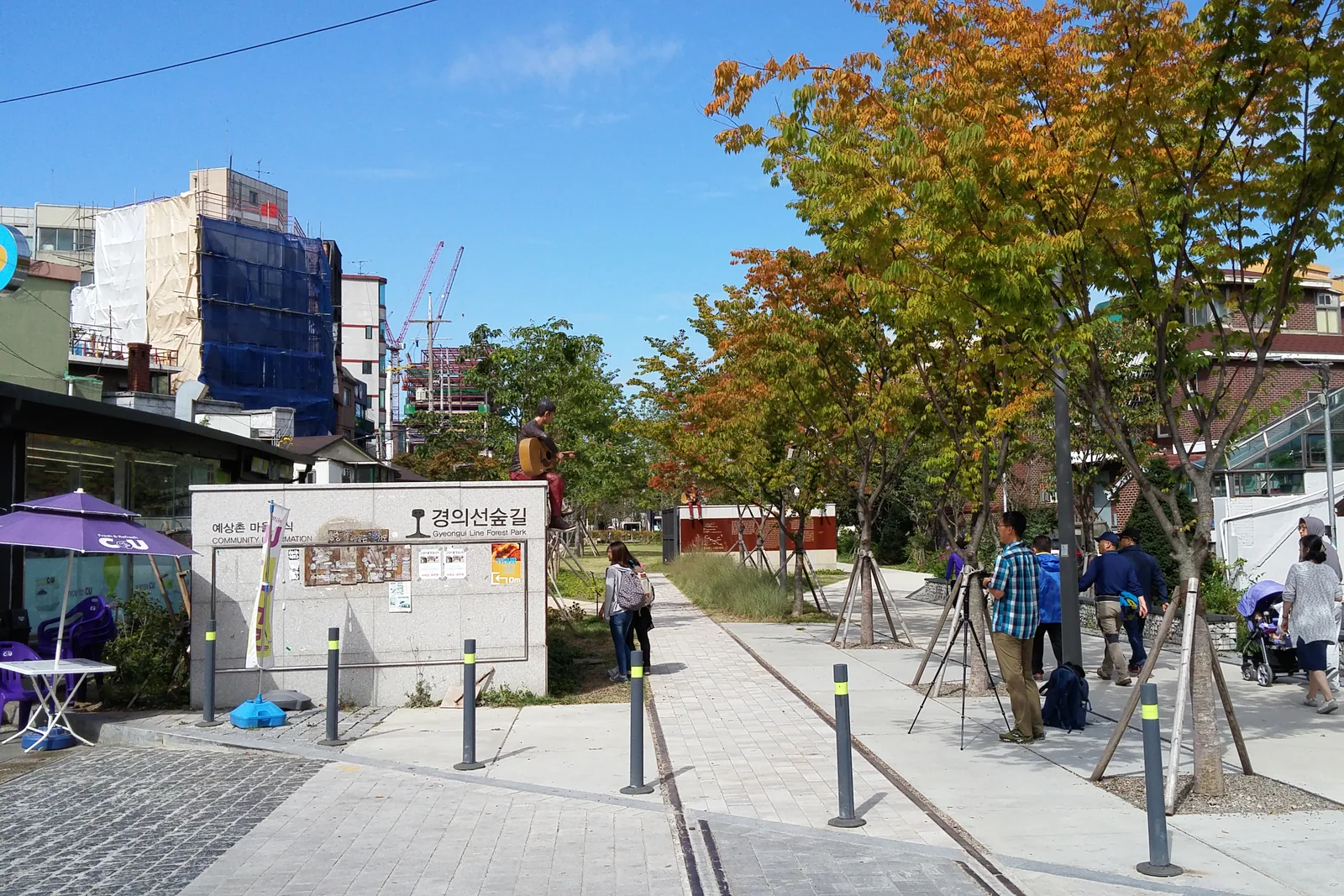
The station opens into several distinct street environments: dense commercial blocks, the university-facing area, and routes toward quieter Yeonnam streets and the Gyeongui Line Forest Park. Decide which environment contains the destination before joining the largest flow of passengers. A numerically close exit can still create a longer walk when the address lies across a broad junction or on the far side of the rail corridor. Check the first two street turns while still indoors, then save the entrance used once outside. For an evening arrival, keep the property name and telephone access available offline; a bright shopping street may be easy to recognize but still be the wrong direction for a guesthouse on a residential side street.
Plan luggage and step-free needs before the final corridor
Large bags change the best route through Hongik University Station. The shortest line on a map may include stairs, crowded passages, or a street segment that is awkward for wheels. Check current facility information on the relevant operator site before departure, then follow the signed accessible route inside because lift availability and work areas can change. Do not commit the whole group to a stairway while one person is still checking the address. If storage is part of the day, confirm its provider, access conditions, and retrieval plan rather than assuming a vacant locker. Keep documents, medicine, valuables, and batteries with their owner, and protect enough space to turn around without blocking commuter flow.
Build a Hongdae visit in one geographic direction
A useful Hongdae visit does not need to cross every subdistrict. Choose one anchor such as an accommodation check-in, a ticketed performance, a reviewed shop, or a meal area, and arrange optional stops along the same side of the station. A route toward Yeonnam and the linear park has a different shape from an evening focused on the university-side commercial streets. If Mangwon Market or the river is the real goal, open that destination's guide and treat it as a separate onward journey rather than describing all of western Seoul as walkable Hongdae. Finish near a known station entrance or an independently confirmed pickup point, and remove the farthest optional stop before fatigue turns the return into another navigation problem.
Recheck the airport leg, station route, and return independently
Use Airport Railroad for the live airport-service layer, Seoul Metro for current city-rail and facility information, and Visit Seoul for destination context. Reopen the source that matches the actual journey shortly before travel; one page cannot guarantee a platform, exit status, lift path, fare, or last departure. On arrival, let official displays and staff instructions override an old map image. Before the evening begins, save the correct operator, return entrance, accommodation address, and a road-based fallback. A practical Hongik University Station sequence is exact address, correct operator, suitable public concourse, destination-side exit, and one coherent neighborhood direction. That sequence remains useful even when a service notice or temporary barrier changes the detailed path.