Use the route below for planning, then open the linked sources for details that can change.
Identify the terminal and the journey purpose first
Gimpo Airport Station can serve an arriving passenger, a departing passenger, an airport-to-airport connection, or an ordinary city-rail journey. Those tasks do not share the same urgency or terminal path. Write down whether the flight uses Gimpo's domestic or international passenger facilities, the operating airline, and the final city or airport destination. A route result that says Gimpo Airport Station does not complete the walk between the rail concourse and the correct airline zone. Travelers connecting to Incheon should also keep the Incheon terminal and ticket responsibility visible. Defining the purpose first prevents city-bound signs, terminal signs, and rail-transfer arrows from being combined into one vague airport direction.
Complete the airport process before choosing a rail path
After a flight, baggage collection and the applicable arrival process come before ground transport. Before a departure, airline check-in, baggage acceptance, document checks, security, and the gate remain more important than minimizing the station walk. Do not plan from scheduled landing time or train arrival alone. Build margin around the complete airport sequence and follow current Korea Airports Corporation terminal guidance. If a bag is delayed or the airline instruction changes, resolve that issue before committing to a city transfer. A passenger using separate tickets for another flight must understand who bears the missed-connection risk; a convenient rail link does not create airline protection or shorten mandatory processing at the next airport.
Choose the rail service from the final destination
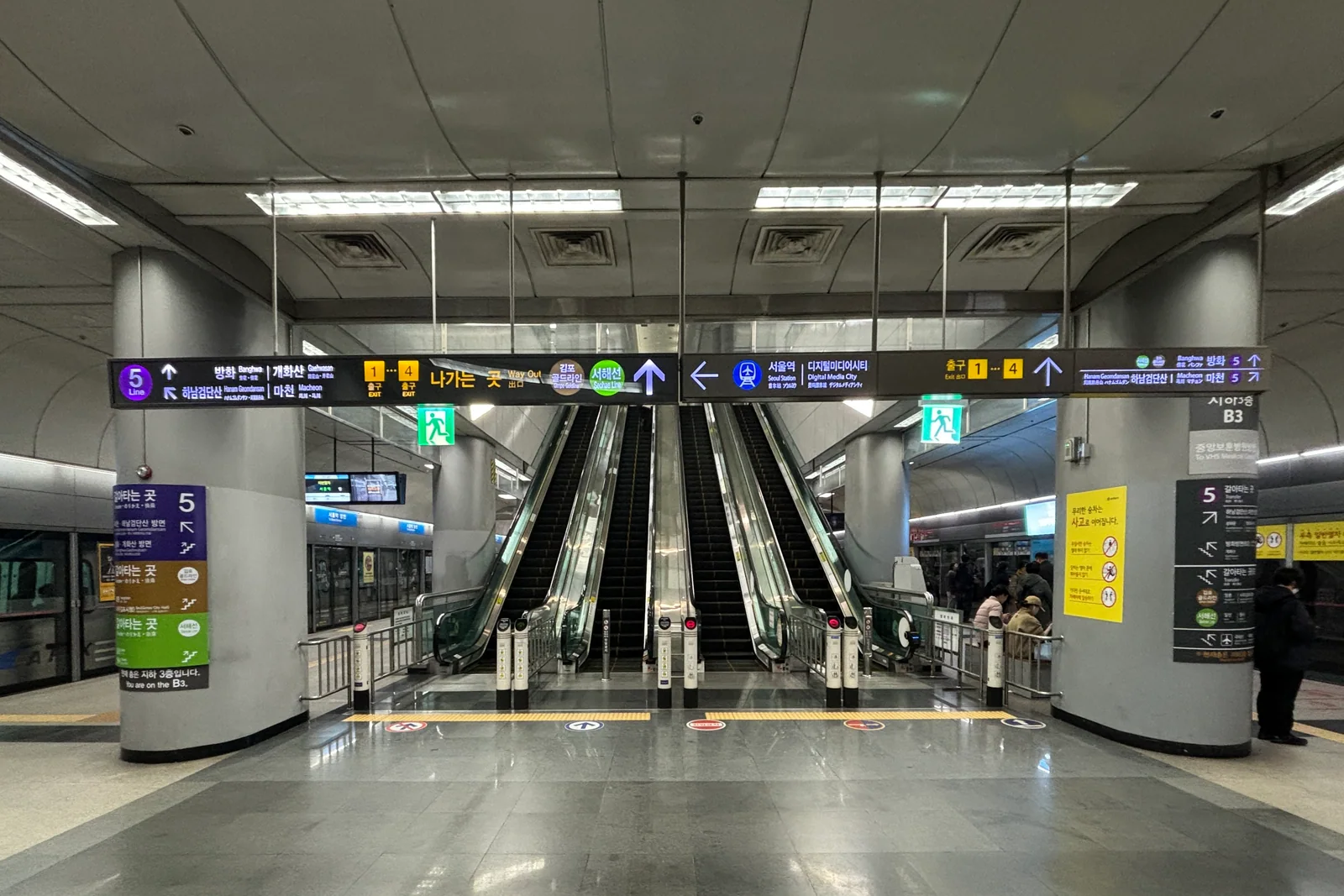
Several rail choices meet around Gimpo Airport, so confirm the operator, direction, and final station rather than boarding from a familiar line color. Airport Railroad is relevant to Incheon Airport and selected Seoul connections, while other city routes may better fit a particular accommodation or district. Use current operator journey information to compare the entire trip, including transfers and the last walk with luggage. Keep the destination address open until the correct platform is confirmed. If the group reaches an unexpected operator area, stop and rebuild the route from the current concourse instead of tapping through another gate. A rail service that passes the airport name may still be traveling away from the required terminal or city endpoint.
Treat a Gimpo–Incheon connection as a full airport change
An airport change includes arrival processing at Gimpo, terminal-to-station movement, the rail journey, arrival at the correct Incheon terminal, and a new airline departure process. Confirm the operating airline and Incheon terminal before leaving Gimpo, and use the official airport connection guidance rather than a generic map estimate. Separate tickets can require baggage collection and a completely new check-in; contact the airline or booking channel if the inbound journey is delayed. Keep enough margin for walking, queues, document questions, and a wrong-platform correction. A private road transfer may reduce bag handling for some groups but remains exposed to traffic and does not remove security, baggage, or terminal obligations at Incheon.
Keep luggage and accessibility needs visible
Check the current terminal and rail facility information before travel when the group uses a wheelchair, stroller, mobility aid, or oversized luggage. The shortest schematic transfer can involve long corridors or a lift route that differs from the main passenger flow. Keep travel documents and essential medicine with their owner, and do not divide the group between a ticket machine and a terminal path without an agreed meeting point. If baggage storage is considered for a city stop, verify the provider, size rules, retrieval route, and effect on the departure margin; an empty locker is never guaranteed. On a same-day flight connection, skip optional sightseeing rather than letting storage or a meal create another deadline.
Recheck terminal, rail, and connection sources
Use Gimpo Airport for current terminal and ground-access information, Airport Railroad and the relevant city operator for the rail layer, and Incheon Airport guidance for an airport-to-airport connection. The airlines remain authoritative for ticket protection, check-in, and baggage. This guide does not hard-code a fare, timetable, platform, minimum connection, or guaranteed accessible path. Reopen every source on the travel date and follow current signs from the actual terminal. A practical approach is journey purpose, correct terminal, completed airport process, destination-based rail choice, and enough margin for the next mandatory task. When uncertainty remains, protect the flight or reserved journey before adding any optional city activity.